
Cool Hope and the Chaining of Bullebach — Full Description
Symbolism and Meaning in Cool Hope and the Chaining of Bullebach
A Descent Into Terror, and the Cool Hope That Rose After
This painting comes from a day I descended deep into the Platte Clove ravine—three miles into the place locals call Devil’s Kitchen, one of the most dangerous corners of the Catskills. The cliffs fall away in sudden 100‑to‑300‑foot drops, the water levels shift without warning, and the ground itself is a tangle of unstable boulders and moss‑slick stone. Local records and warnings suggest that more than two hundred people have died in Platte Clove and the surrounding Devil’s Kitchen terrain over the past two centuries. When you’re down inside it, you feel that history in your bones.
I entered the gorge under a sky already heavy with cold rain. The deeper I went, the more the world narrowed—mist rising, waterfalls crashing into dark pools, the forest pressing so tightly against the cliffs that the sky simply disappeared. Then the storm broke. Thunder rolled through the ravine like cannon fire. Sheets of rain poured down the walls. Fog thickened until the trail dissolved into a blur of dripping branches and roaring water.
That was when the sound began.
Rocks—large ones—tumbling down the slopes behind me. Rolling, clattering, gathering speed. Not random. Not natural. It felt deliberate, as if something unseen was pushing them, tracking me through the ravine. In that moment, the Catskills’ old legends came alive. The thunder boomed like Henry Hudson’s ghostly crew bowling in the mountains. But unlike Rip Van Winkle, I wasn’t drifting into enchanted sleep—I was scrambling over slick boulders, ducking under fallen trees, bushwhacking along slopes where one slip meant a fall into darkness. The sense of pursuit grew with every rockfall. Something was following me. Something ancient.
That presence followed me into the painting.
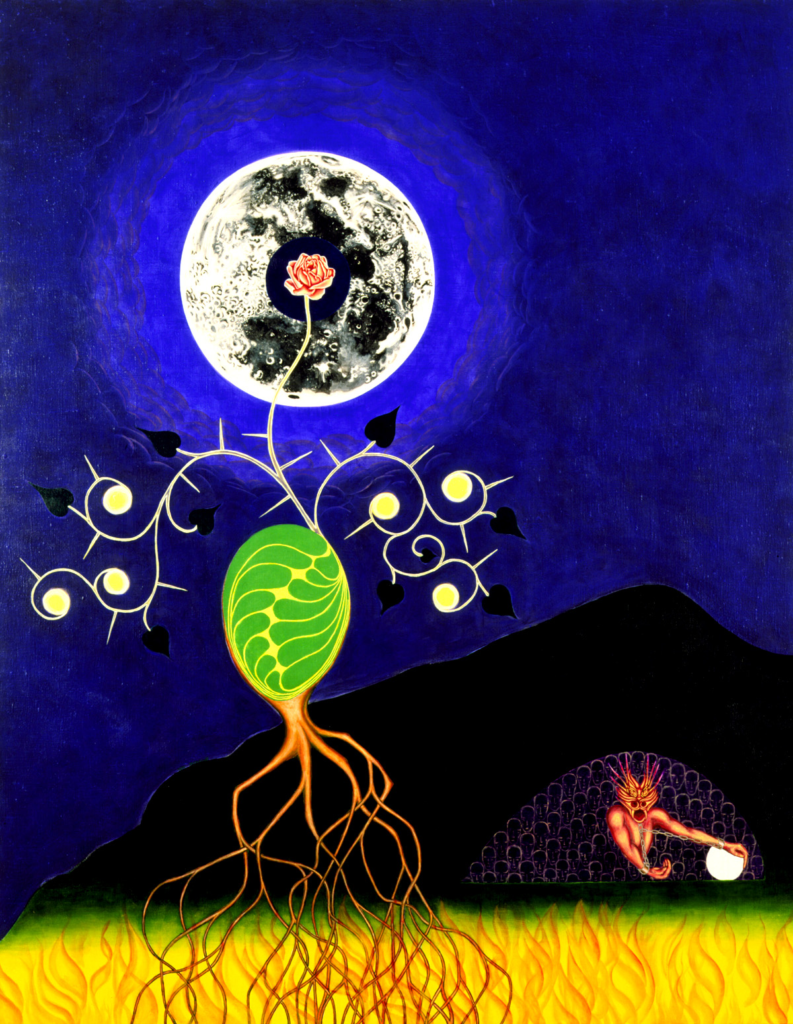
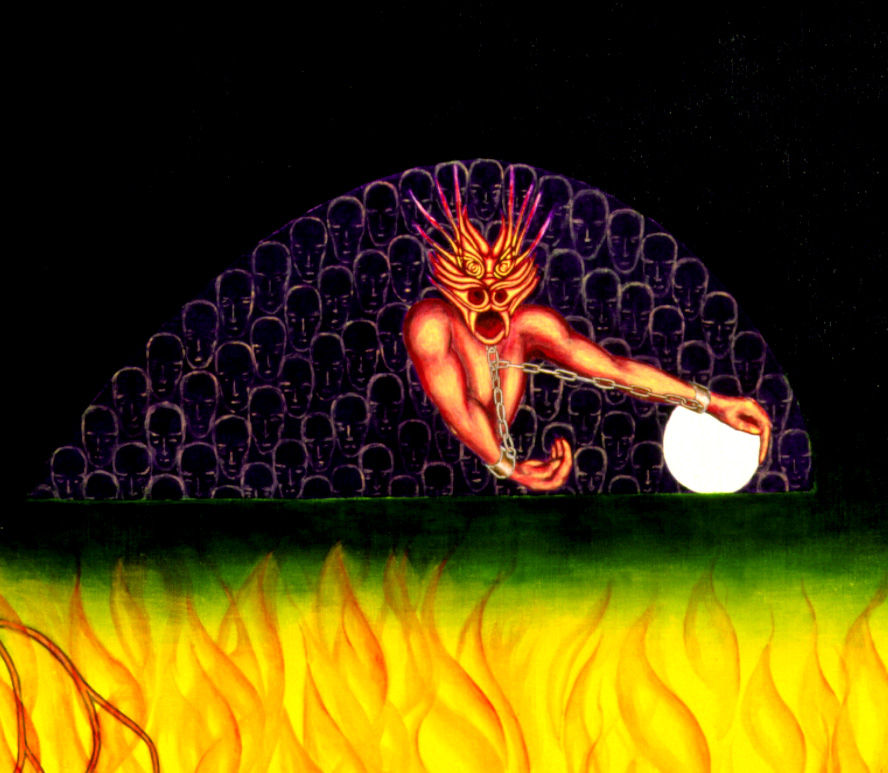
In the lower right, the demon‑dragon Bullebach emerges from the cave mouth. I’ve heard the stories of him haunting Platte Clove, but in that storm—dark, echoing, alive with the movement of stone—he felt less like folklore and more like a force I recognized. In the painting, he becomes the shape of the inner adversary: the instinctive impulses that rise unbidden—fear, anger, greed, the old animal inheritance that shadows the human heart.
The chaining of Bullebach is the central act. It is the struggle to hold those forces still long enough to transform them—the discipline of choosing clarity over rage, compassion over the darker pull of the self.
But before the chaining came the escape.
I climbed and slipped my way toward the mouth of the gorge, each thunderclap shaking the ravine. And then—suddenly—the storm thinned. The rain lifted. Light returned. I stepped out of the darkness and into a clearing sky, saved by the simple fact of reaching daylight.
That moment—when terror breaks and morning arrives—is the heart of this painting.
A thorned, root‑hung plant rises against a cool, starless moon, crowned with a single rose. For me, that rose is redemption—the fragile beauty that survives even in places shaped by shadow and gravity. It is the small, steady truth that endures after fear has spent itself. It is the hope that grows where it should not.
Below it, the flames still burn—the heat of the ordeal, the panic of the storm, the presence that pursued me through the ravine. And in the lower right, Bullebach remains, chained at last. He is not destroyed; he is held. Contained. Understood. The darker inheritance of the self brought into the light where it can no longer rule.
Cool Hope and the Chaining of Bullebach is the vision of that threshold:
the moment when the inner landscape shifts,
when the shadow loosens its grip,
when the heart remembers its own clarity.
Even in the deepest gorge—whether carved in the mountains or within the soul—something luminous can rise.
The Chained Dragon Bullebach
“Cool Hope and the Chaining of Bullebach ultimately becomes a reflection on how the human spirit confronts its own darkness and rises toward renewal.”